



Why Automatic Weight Sorting Improves Seafood Production Efficiency
In seafood processing plants, weight sorting is a critical step that directly affects pricing accuracy, production efficiency, and labor cost control.
Yet many processors are still relying on manual sorting — a method that is increasingly difficult to sustain.
By comparing manual oyster sorting with automatic weight sorting, the advantages of automation become clear.

The Hidden Costs of Manual Sorting
At first glance, manual sorting may seem flexible and low-cost. In reality, it brings several long-term challenges:
• Inconsistent weight accuracy
Human judgment varies from worker to worker, leading to uneven product grades.
• High labor dependency
Production speed depends entirely on worker availability and experience.
• Low efficiency under growing demand
As order volumes increase, manual sorting quickly becomes a bottleneck.
• Difficulty maintaining stable output
Fatigue and turnover directly impact productivity and quality.
For seafood processors facing rising labor costs and stricter quality requirements, manual sorting limits scalability.
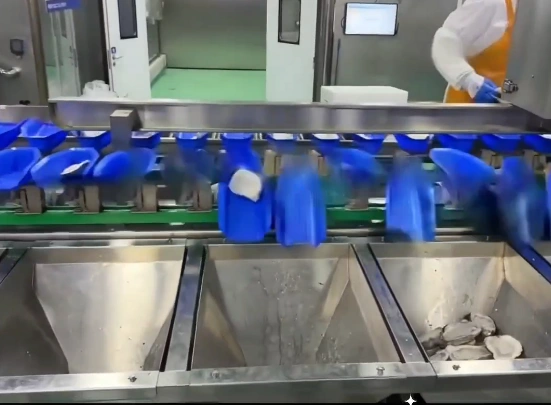
How Automatic Weight Sorting Solves These Problems
Automatic weight sorting systems are designed to deliver consistent, repeatable, and efficient results.
Compared with manual sorting, automated solutions offer:
• High-precision weighing
Accurate weight detection down to 0.1 g ensures consistent grading.
• Stable and continuous operation
Machines maintain the same performance level throughout the production cycle.
• Reduced labor dependency
Fewer operators are needed, lowering long-term labor costs.
• Higher throughput
Automated sorting keeps pace with modern seafood processing demands.
Designed for Seafood Processing Applications
Modern weight sorting machines are engineered specifically for seafood products such as oysters, shellfish, and other irregular-shaped items.
Key features include:
• Adaptability to wet processing environments
• Intelligent software for fast calibration and tare adjustment
• Customizable sorting ranges based on product size and weight
These systems are not one-size-fits-all — they are tailored to real production conditions.
From Manual Labor to Automated Efficiency
The transition from manual sorting to automatic weight sorting is not just a technology upgrade.
It is a strategic decision to improve consistency, efficiency, and long-term competitiveness.
For seafood processors aiming to scale production while maintaining quality standards, automation is no longer optional — it is becoming essential.
Looking to upgrade your sorting process?
We specialize in customized weighing and weight sorting solutions for seafood and food processing applications.
If you are considering automation, understanding your production needs is the first step.
Get a Quote
*RequiredPlanning to upgrade your weight sorting system?
Share your application details and our team will recommend a suitable solution.