



How to Choose a Poultry Weight Grading Machine
(A Practical Guide for Poultry Processing Plants)
Introduction
Choosing the right poultry weight grading machine is a critical decision for poultry processing plants. Accurate weight sorting directly affects product consistency, pricing strategy, labor efficiency, and overall profitability.
With many suppliers offering different solutions, understanding the key selection criteria helps processors avoid costly mistakes and invest in a system that fits their production needs.
This guide explains how to choose a poultry weight grading machine based on processing capacity, accuracy, application scenarios, and long-term reliability.
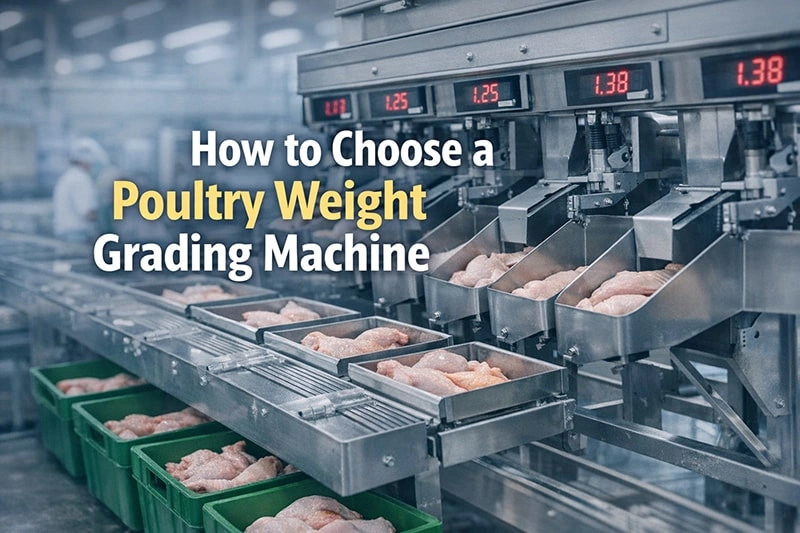
1. Understand Your Poultry Processing Requirements
Before selecting a poultry weight grading machine, processors should clearly define their operational needs.
Key questions to consider:
• What type of poultry products are processed? (whole chicken, parts, frozen or fresh)
• What is the required throughput per hour?
• How many weight categories are needed?
• Will the machine be integrated into an existing processing line?
For export-oriented plants in Southeast Asia and the Middle East, stable performance under continuous operation is especially important.
2. Accuracy and Stability Matter More Than Speed
High-speed operation is important, but accuracy and long-term stability are even more critical.
A reliable poultry weight grading machine should offer:
• Consistent dynamic weighing accuracy
• Minimal deviation under high-speed conditions
• Stable performance during long production shifts
Inaccurate grading can lead to product inconsistency, customer complaints, and financial losses. Processors should prioritize machines designed for industrial-grade continuous operation.
3. Choose the Right Sorting Technology
Modern poultry weight grading machines typically use dynamic weighing systems combined with intelligent control technology.
Key technical aspects to evaluate:
• Sensor quality and response speed
• Conveyor design and vibration control
• Intelligent weight classification algorithms
• Smooth and precise sorting mechanisms
Advanced systems ensure accurate grading even when processing large volumes at high speed.
4. Flexibility for Different Weight Ranges
Poultry processors often need to handle products with varying weight ranges depending on market demand.
An ideal poultry weight grading machine should allow:
• Easy adjustment of weight categories
• Flexible configuration for different product sizes
• Quick changeover between grading programs
This flexibility helps processors adapt to different customers, export standards, and seasonal demand.
5. Application Experience in Poultry Processing
Not all weight sorting machines are designed specifically for poultry.
When choosing a supplier, it is important to verify:
• Experience in poultry processing applications
• Proven installations in poultry plants
• Understanding of slaughtering and processing workflows
Machines designed specifically for poultry processing deliver better performance, hygiene compatibility, and operational reliability.
6. Compliance with Export and Halal Processing Standards
For Southeast Asia and Middle East markets, compliance is a key consideration.
A suitable poultry weight grading machine should:
• Support hygienic design requirements
• Be compatible with halal processing workflows
• Meet common export and food safety standards
This ensures smooth certification and acceptance in international markets.
Get a Quote
*RequiredPlanning to upgrade your weight sorting system?
Share your application details and our team will recommend a suitable solution.